AI Runs on Electricity: The Power Bill Behind the Model Race
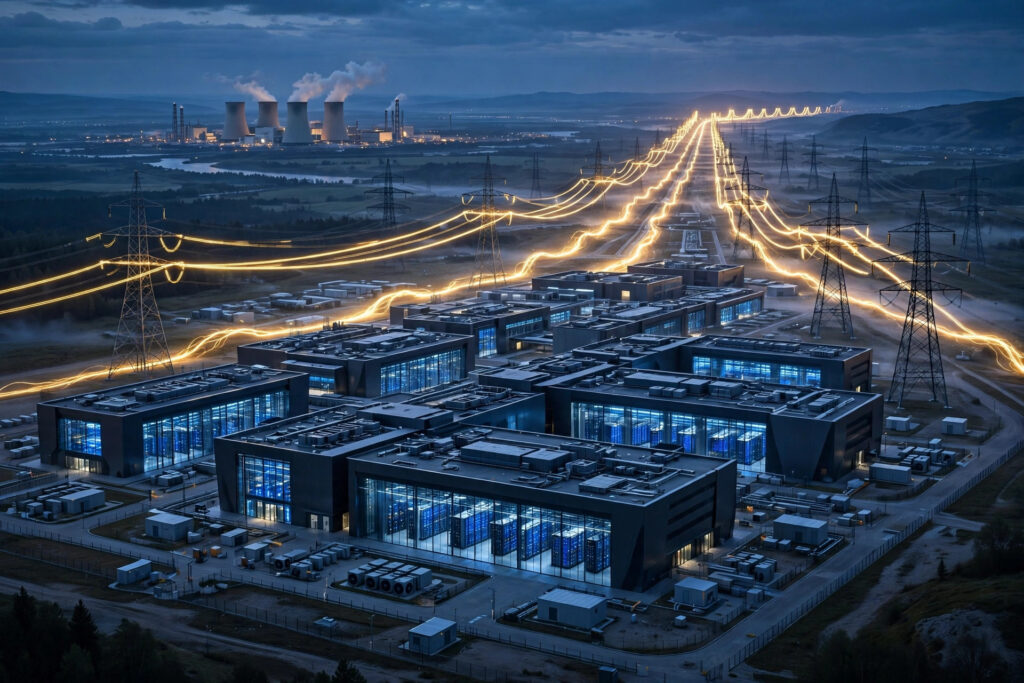
Every conversation about AI eventually becomes a conversation about electricity. Not metaphorically — literally. The model race is usually told as a story about chips and talent and training runs, but the binding constraint of 2026 is none of those. It is megawatts. The companies building the future of intelligence have discovered that intelligence, at scale, is a power product — and the grid they need was built for a different century, at a different speed, for customers who did not double their appetite every year.
This is the part of the AI story that shows up in physics before it shows up in products: what happens when the most valuable technology on Earth runs headfirst into the slowest-moving infrastructure on Earth.
The appetite, in numbers
The International Energy Agency has become the scorekeeper. Its figures: data centres consumed about 415 terawatt-hours of electricity in 2024 — roughly 1.5 percent of all electricity used on the planet. In 2025 that rose to about 485 TWh, up 17 percent in a year when total global electricity demand grew about 3 percent. Electricity use by AI-focused data centres rose 50 percent in that single year. The IEA’s projection has barely moved across two reports, which makes it more credible, not less: roughly 950 TWh by 2030 — about 3 percent of global electricity, or approximately the entire consumption of Japan, spent on data centres.
Scale it down to something graspable. A typical AI-focused data centre draws as much power as 100,000 households. The largest facilities now under construction draw twenty times that — a mid-sized city’s worth of electricity, pointed at a single customer’s models. And the demand is lumpy in a way grids hate: a training cluster does not sip power politely around the clock curve. It arrives as a gigawatt-scale block, in one place, on one deadline, and it does not negotiate.
The queue is the story
Supplying that power is not mainly a money problem. The world’s largest data centre operators are on pace to spend more than $700 billion in 2026, most of it on infrastructure. Money is the one input they have. What they cannot buy is time.
In the United States, the line to connect new generation to the grid holds more than 2,600 gigawatts of proposed capacity, with median waits stretching past eight years in industry analyses. Transformers, switchgear and turbines carry multi-year backlogs of their own. The IEA estimates about a fifth of planned data centre projects could be delayed without action on grids — and industry trackers estimate 30 to 50 percent of the data centre capacity planned for 2026 will slip toward 2028.
The squeeze is visible in prices. PJM, the grid operator for 13 states including Virginia’s data centre alley, holds an annual auction for capacity — a payment for power plants to simply be available. For years it cleared under $30 per megawatt-day. Then: $269.92 for 2025/26, and the regulatory cap — $329.17 — for 2026/27, where it has stayed. PJM’s independent market monitor attributes $6.3 billion of this year’s $16.4 billion in capacity charges to data centre load alone. When a grid’s availability price rises elevenfold in two auction cycles, the grid is telling you something: the electrons are spoken for.
The nuclear turn
Watch what the hyperscalers did next, because it is the clearest signal in the whole story. They stopped waiting in line and started buying power plants.
Microsoft signed a 20-year agreement with Constellation Energy to restart Three Mile Island Unit 1 — shuttered in 2019, renamed the Crane Clean Energy Center — 835 megawatts of nuclear output, targeted to return in 2028, flowing entirely to Microsoft’s data centres. Google signed a 25-year deal with NextEra to restart Iowa’s Duane Arnold plant, closed in 2020, targeted for early 2029. Amazon expanded its agreement with Talen Energy to 1,920 megawatts of nuclear power through 2042. Google also holds the first corporate small-modular-reactor deal, with Kairos Power; Amazon has backed X-energy toward more than five gigawatts of SMR capacity by 2039; Meta has gone shopping for one to four gigawatts of new nuclear. Trackers put the collective Big Tech nuclear commitment at roughly 9.8 gigawatts.
Three shuttered reactors being resurrected and a reactor technology that barely exists yet being bought by the gigawatt — by software companies. That is not a public-relations strategy. That is what it looks like when the largest buyers of electricity in history conclude that the shared grid cannot feed them on their schedule, and decide to become power companies in all but name.
The efficiency paradox
There is one counterweight, and it is real: the energy cost of intelligence is collapsing. The IEA notes that energy use per AI task has fallen by at least an order of magnitude per year in recent years — better chips, better architectures, better software. A query that took a watt-hour takes a tenth of that, then a hundredth.
And total demand doubles anyway. This is the oldest pattern in energy economics — Jevons’ paradox, from coal in 1865: make a resource cheaper to use and the world uses more of it, faster than the efficiency gains can offset. Cheaper inference does not shrink the power bill. It moves AI into everything — every app, every workflow, every agent running around the clock — and the aggregate load climbs the curve the IEA drew. Efficiency decides who profits per query. It does not decide whether the grid grows. The grid grows. We mapped the emissions side of this ledger in The Hidden Carbon Footprint of Large-Scale AI; this is the other half — not what AI emits, but what it consumes, and who gets to consume it.
What changes when AI is priced in power
Expect power to leak into prices. API costs, cloud regions, and subscription tiers will increasingly track the cost and availability of the power behind them. The cheapest region will be the one with electrons, not the one with marketing. When a provider’s prices move, ask what their power contract looks like — that is now a product question.
Treat efficiency as a skill, not a setting. Model choice is now an energy decision: the small model that answers in a tenth of the compute is a tenth of the power bill, yours or your provider’s. Routing easy tasks to small models, batching heavy work, and running open models locally where it fits — these stop being optimizations and become the craft.
Discount timelines that ignore the grid. Any AI roadmap that assumes unlimited capacity on a date certain is a press release, not a plan. Build with slack: the model you can access today, at the price you can pay today, beats the frontier model promised for a data centre that is still waiting on a substation.
Watch the map redraw itself. AI gravity is moving toward power: nuclear country in Pennsylvania and Iowa, gas and sun in Texas, hydro in the Pacific Northwest and Quebec. Jobs, startups, and infrastructure money follow the electrons. Where the power is cheap and permitted is where the industry physically happens.
Build while access is cheap. If anything, the power crunch argues for building now. API access, tooling, and model capability are never more generous than they are before the constraint binds — and the builders who learned the tools while electrons were abundant will own the workflows when intelligence is rationed by price.
Underneath the model race, quietly, the grid is being rebuilt to feed it — restarted reactors, elevenfold capacity prices, a $700 billion construction year. The model race looks like software. The bill says otherwise.